
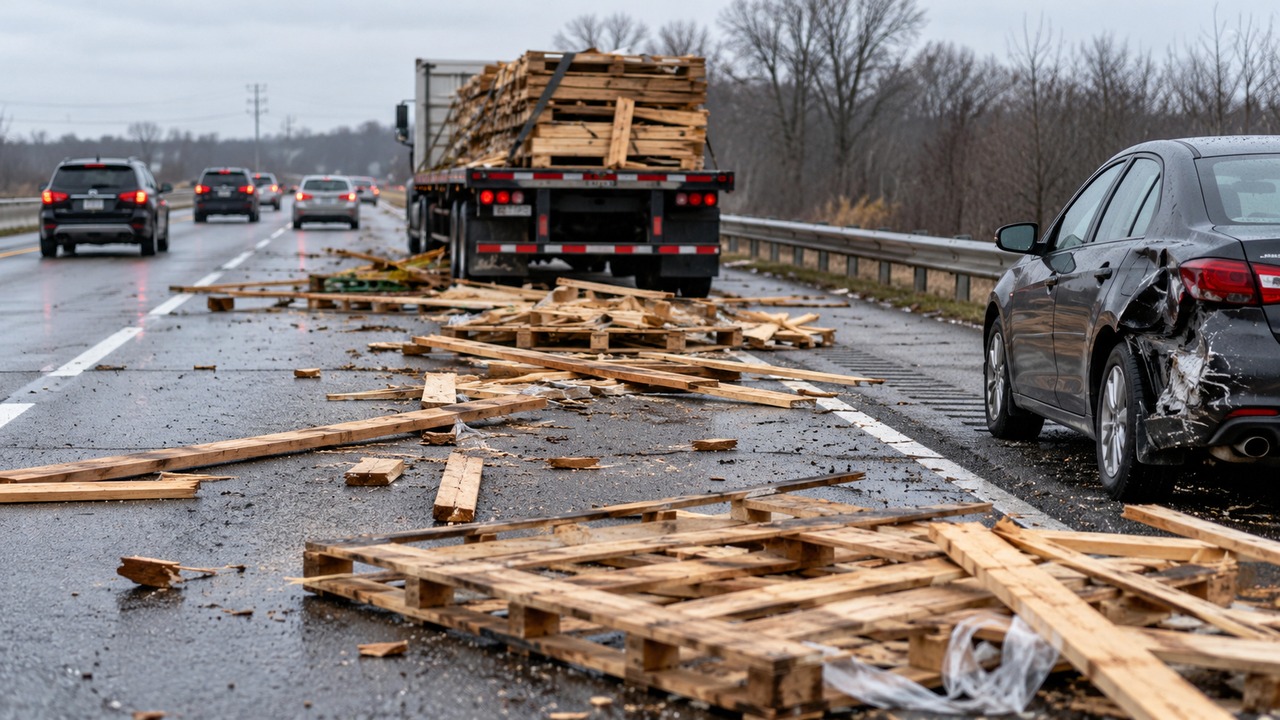
Drivers, Trucking Companies, Shippers, and Loaders Can All Share Responsibility for Falling Cargo
Cargo that falls from a truck on an Ohio highway can shatter a windshield or block a lane without warning. Lumber, steel coils, pallets, gravel, and construction equipment all become dangerous when they aren't tied down. On busy routes like Interstate 71, Interstate 77, and Interstate 480, one unsecured load can set off serious truck crashes. Drivers behind the truck often have only a split second to react.
These crashes happen more often than many drivers realize. The AAA Foundation for Traffic Safety estimates that road debris was a factor in about 319,724 crashes from 2018 through 2023. Those crashes caused 32,802 injuries and 433 deaths nationwide. Crashes in which a driver swerved to avoid debris tended to be more severe than those in which a vehicle hit the debris directly.
Our Cleveland truck accident lawyers at Merriman Legal, LLC help injured people find out who failed to secure a load. That answer often involves more than one company. The driver, carrier, and loading crew may all be involved. Identifying every responsible party early can make a major difference in what an injured person recovers.
|
Key Takeaways
|
What Does Ohio Law Require for Truck Loads?
Ohio sets a clear rule for every vehicle on the road. Ohio Revised Code Section 4513.31 bars driving a vehicle unless it's loaded or covered to keep cargo from escaping. That covers anything that drops, leaks, or sifts onto the road. Loose materials like trash and boxes must also be covered so they don't blow or bounce off.
Commercial trucks face additional federal rules. Federal Motor Carrier Safety Administration rules require drivers to inspect cargo and securement devices early in every trip. That first check must happen within 50 miles. After that, drivers must recheck the load every three hours, every 150 miles, or at each change of duty status.
A driver who skips those checks may be breaking rules designed to prevent these crashes. The same is true of a company that pressures drivers to skip them. Violations of safety rules can serve as strong evidence that someone failed to act with reasonable care. That evidence often shapes how an insurer responds to a claim.
Who Can Be Liable When Cargo Falls From a Truck?
Falling cargo crashes rarely trace back to a single mistake. Liability often depends on who loaded the truck and who secured the cargo. It also depends on who had a chance to catch the problem before the truck hit the road. Several parties may share responsibility.
- The Truck Driver – Drivers must confirm cargo is secured before leaving and recheck it during the trip, adding straps or adjusting the load when needed.
- The Trucking Company – Carriers are generally responsible for their drivers' conduct and may also be liable for poor training, worn tie-downs, or schedules that discourage inspections.
- The Shipper or Loading Company – When a trailer is sealed or loaded so the driver can't inspect the cargo, the company that packed it may carry much of the responsibility.
- The Equipment Manufacturer – A strap, chain, binder, or trailer latch that fails because of a defect can support a defective products claim against the company that made it.
Each of these parties may have its own insurer, and each will likely point to someone else. A driver may blame the warehouse crew that loaded a sealed trailer. The shipper may blame the driver for not checking the load. Sorting through those stories takes a careful investigation of the trucking company and everyone else involved.
Common Cargo Failures and Who May Be Responsible
The way cargo comes loose often points to who made the mistake. A snapped strap tells a different story than a trailer door that burst open. Each failure can lead investigators toward different companies and different records. Here's how some common failures can connect to the parties involved.
| Type of Failure | Example | Parties Often Investigated |
|---|---|---|
| Too few tie-downs | Lumber or pipe slides off a flatbed in a turn | Driver, trucking company, loading crew |
| Worn or damaged straps | A frayed strap snaps at highway speed | Trucking company, driver |
| Shifted load in a sealed trailer | Pallets push open a rear door | Shipper, loading company, trucking company |
| Uncovered loose material | Gravel or debris flies off a dump truck | Driver, hauling company |
| Defective securement equipment | A ratchet binder or latch fails under a normal load | Equipment manufacturer, trucking company |
These categories often overlap. A worn strap on a poorly loaded trailer can involve the carrier, driver, and loading crew at once. That's why physical evidence from the scene matters so much. The straps themselves can show whether they were frayed, cut, overloaded, or simply never attached.
How Ohio Divides Fault Among Several Companies
When more than one party caused a crash, Ohio assigns each one a percentage of fault. Ohio Revised Code Section 2307.22 sets out how that works. A defendant found more than 50% at fault can be held responsible for all economic losses, such as medical bills and lost wages. A defendant 50% or less at fault generally pays only its own share.
Non-economic losses, such as pain and suffering, are split by each defendant's share of fault. Under Ohio Revised Code Section 2307.23, a jury can also assign a percentage of fault to a company the injured person didn't sue. In practice, leaving a responsible shipper or loader out of a claim can shrink what an injured person collects.
Insurers may also try to blame the injured driver for following too closely or failing to avoid the debris. Under Ohio's comparative negligence rule, an injured person can still recover if their share of fault isn't greater than everyone else's combined. Any award drops by their percentage of fault, so pushing back on those arguments matters.
Evidence From a Cargo Spill Disappears Quickly
Imagine a driver heading north on Interstate 77 near Independence. A steel coil breaks loose from a flatbed ahead and crashes into her car. Within hours, crews clear the road and tow the damaged vehicles. The broken straps may end up in a scrap pile or back with the trucking company before anyone examines them.
That's why speed matters. Key evidence can include the straps and binders, bills of lading, and loading records. Driver inspection reports, dashcam footage, and scene photos can also prove what went wrong. Our Rapid Response Team works to preserve that evidence and find witnesses before details are lost.
Timing matters for the lawsuit too. Under Ohio Revised Code Section 2305.10, most bodily injury lawsuits must be filed within two years. Falling cargo crashes can cause catastrophic injuries that take months to fully understand. Starting the investigation early protects both the evidence and the claim.
Getting Answers After a Falling Cargo Crash
A falling cargo crash can leave injured people facing several companies, several insurers, and plenty of finger-pointing. Each company has a reason to shift blame elsewhere. A strong claim traces the load from the warehouse floor to the highway. It shows exactly where the system broke down.
Our Ohio truck accident attorneys investigate every company involved in loading, securing, and hauling the cargo. Managing partner Tom Merriman and our team work to identify each responsible party and its insurance coverage. We also document the full impact of your injuries, from medical care to lost income.
If cargo from a truck injured you or a loved one, talk with our team about your case. Your first consultation is free, and we can start investigating right away. We handle these cases on a contingency fee basis. You don't pay attorney fees unless we recover compensation for you.
"It was an absolute pleasure working with Tom and his team during my personal injury claim. Tom is exceedingly knowledgeable about personal injury law. He has the highest of ethics, and he is very personal and professional. He kept me informed throughout the entire process. He went above and beyond to get me the maximum amount possible. I highly recommend Tom and his team." — Donna, ⭐⭐⭐⭐⭐